Hardly a week goes by now without a client asking us about GEO. Sometimes it’s “can you get us showing up in ChatGPT?” Sometimes it’s a quote from another agency with “Generative Engine Optimisation” as its own line item, usually with a healthy monthly fee attached.
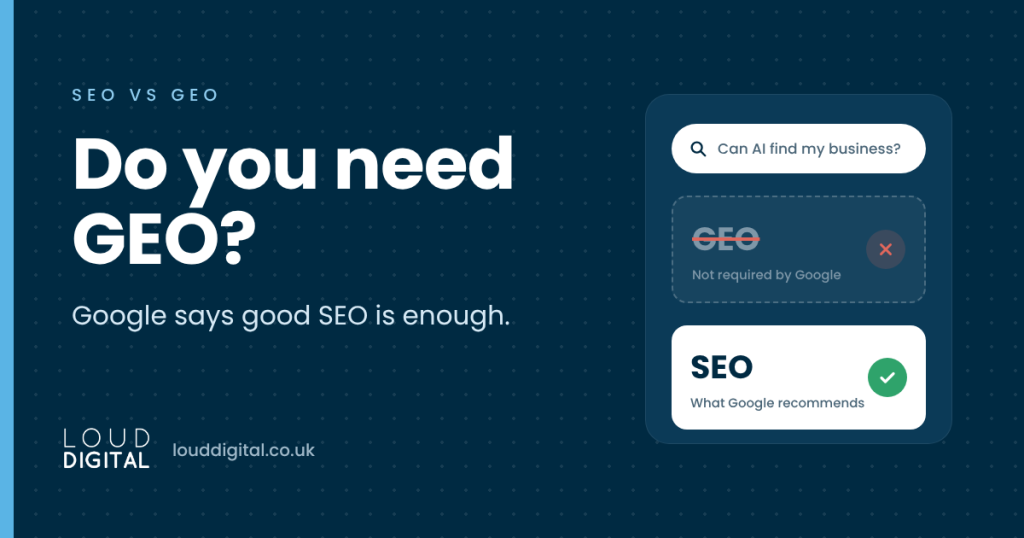
GEO is the idea that your website needs a separate kind of optimisation to appear in AI tools like ChatGPT and Google’s AI Overviews. Our answer is the same one we give on the phone: if your SEO is done properly, you don’t need to pay extra for GEO. And that’s not just our opinion. Google has put it in writing.
We’ve been building and optimising websites since 2010, so we’ve seen this film before. Every few years a new acronym turns up with a price tag attached, and every time, the businesses that come out on top are the ones that kept getting the basics right.
What Google actually says about AI Overviews and AI Mode
Google’s Search Central documentation has a page dedicated to AI features and your website. It’s worth a read, but the key line is this:
“There are no additional requirements to appear in AI Overviews or AI Mode, nor other special optimizations necessary.”
To appear as a supporting link in an AI Overview, a page needs to be indexed and eligible to show in Google Search with a snippet. Those are exactly the same requirements as a normal search result. There’s no separate AI index to get into and no extra hoop to jump through.
So if someone tells you there’s a special formula for getting into Google’s AI answers, they’re telling you something Google itself says isn’t true.
Google’s “AI checklist” is the SEO checklist
Rather than anything new, Google points site owners back to the SEO fundamentals. Here’s its list, and what each point means for a typical business website.
- Let Google crawl your site. Check robots.txt, your CDN and your hosting aren’t blocking it. It sounds obvious, but we regularly find an overzealous firewall or security plugin quietly turning crawlers away.
- Link your pages together properly. If your best service page is only reachable from a footer link, don’t be surprised when Google treats it as an afterthought.
- Give visitors a good experience. Quick to load, works properly on a phone, no pop-up ambush the second someone lands. Handily, these are the same things that help your conversion rate.
- Put important information in text. Prices, service areas and opening hours locked inside images or PDFs are hard for any system to read, AI included.
- Back it up with decent images and video. Where they help the reader. Real photos of your work beat stock images every time.
- Keep your structured data honest. Schema markup is useful, but it has to describe what’s actually on the page.
- Keep Merchant Center and your Business Profile up to date. Opening hours, addresses, prices and product details. This is the information Google leans on most about your business, so it needs to be right.
None of this is new. It’s the work a decent SEO agency should already be doing for you.
What you don’t need to pay for
This is the bit that might save you some money. Google’s guidance goes on:
“You don’t need to create new machine readable files, AI text files, or markup to appear in these features. There’s also no special schema.org structured data that you need to add.”
That rules out a fair chunk of what’s being sold as GEO right now. If you’ve been quoted for an llms.txt file, “AI schema”, a separate set of AI-friendly pages or a monthly GEO retainer on top of your SEO, and the pitch is that it’ll get you into Google’s AI answers, it’s worth asking what it does that Google says you need. Because according to Google, the answer is nothing.
What about ChatGPT and other chatbots?
Fair question, as Google’s guidance only covers Google. There isn’t an equivalent rulebook for every chatbot, but the way they work points the same way. When ChatGPT, Copilot or Perplexity answer a question about something current, or recommend a local business, they generally search the web and summarise what they find.
So the same things matter. Let the crawlers in. Put clear, accurate information on your site. Build a real reputation through reviews and mentions on websites people trust. There’s no back door, and the businesses that get recommended by AI tend to be the ones a person would recommend too.
How to spot GEO snake oil
To be fair, plenty of agencies do good work and call some of it GEO. Labels are labels. The problem starts when the label is the product. A few warning signs to look out for:
- A guarantee you’ll appear in ChatGPT or AI Overviews. Nobody can promise that, and Google says even meeting its requirements doesn’t guarantee a page will be shown.
- A method they can’t, or won’t, explain.
- A GEO fee on top of an SEO fee, where nobody can tell you what’s actually different.
- Files and markup Google has said you don’t need.
- “AI visibility” reports that never mention enquiries, leads or sales.
If you want one question to cut through it, try this: “Which part of this work isn’t already covered by Google’s own SEO guidance?” If the reply is a long pause, you’ve got your answer.
GEO FAQs
What is GEO?
GEO stands for Generative Engine Optimisation. It’s the idea of optimising a website specifically so it appears in AI-generated answers, such as Google’s AI Overviews or ChatGPT.
Is GEO different from SEO?
For Google, no. Google says there are no additional requirements or special optimisations needed to appear in AI Overviews or AI Mode. The same SEO fundamentals apply.
Do I need an llms.txt file?
Not for Google. Its guidance says you don’t need to create new machine readable files, AI text files or special markup to appear in its AI features.
The bottom line
AI is changing how search results look. It hasn’t changed what earns a place in them. Make your site easy to crawl, useful and accurate, keep your Google listings up to date, and you’re as ready for AI search as anyone charging extra for the privilege.
We’re a small, senior team based in Hull, a Google Partner since 2018, and we’d always rather tell you what won’t work than sell it to you. If you’ve been quoted for GEO and want a second opinion, or you’d like us to check your site is set up properly for AI search, get in touch. We’ll give you a straight answer.